How to Turbo Your SBC 350 | Turbo Size, Build Guide, Parts List
Can You Turbo a 350 Small Block?
Turbo setups on small-block Chevys have been done since the early drag racing days, and modern technology has made it easier than ever. The key is assembling the right combination of parts and ensuring the engine is prepared for boost. Here’s a rundown of the essential parts you’ll need for a turbo SBC build:
- Turbocharger assembly: The heart of the system. It can be a single turbo or twin turbos.
- Exhaust manifolds/headers: The turbo is spun up off the power of the rapidly moving exhaust gasses. The exhaust manifold routes exhaust gases from the engine to the turbo’s exhaust inlet flange.
- Wastegate: A wastegate controls boost pressure by venting excess exhaust gas to keep boost at safe levels.
- Intake piping & intercooler: You’ll route compressed air from the turbo to the engine with intake (cold-side) piping. While not strictly required, especially for low boost, an intercooler is highly recommended to cool the air charge and prevent detonation.
- Blow-off Valve: A blow-off valve releases pressure when you let off the throttle, preventing compressor surge. This is another must-have for longevity.
- Fuel system upgrades: Boost means you need more fuel. At minimum, a higher-volume fuel pump and fuel pressure regulator (boost-referenced for carb setups) or larger fuel injectors for EFI are needed. If using a carburetor, it should be a blow-through carb specially built to handle boost or placed in an air-tight carb box.
- Ignition control: Under boost, ignition timing must be managed to avoid knock. An ignition box with a boost-retard function or a programmable EFI ignition timing map is important.
- Engine internals: A stock 350 can handle a modest amount of boost, but if you plan for significant power you’ll need something a bit more stout. We’ll dive deeper into internal upgrades in the next section.
Turbocharging a small block Chevy is entirely doable, but it’s not as simple as bolting on a turbo alone. It requires a collection of parts working in harmony. The good news is companies like Speedway Motors offer complete turbocharger kits that take a lot of the guesswork out of parts selection.
How to Build a Turbo Small Block Chevrolet
Building a turbocharged small-block Chevy is all about preparing the engine to handle boost. The project can range from a budget junkyard turbo build to an all-out racing setup. Start by assessing your SBC 350 engine build. A factory two-bolt-main 350 block can handle moderate horsepower (under 400 or so), but if you’re shooting for big power, a four-bolt-main block or aftermarket is preferred. Check out our guide on 2-bolt main vs 4 bolt mains guide to compare. Many builders freshen the bottom end with forged pistons and forged connecting rods to survive the high cylinder pressure a turbo creates. Upgraded hardware like ARP fasters, rod bolts and head studs and performance main bearings are cheap insurance when adding boost. If you’re aiming north of 500 horsepower, forged internals are strongly recommended. On a more moderate build, a stock crank and rods might live if you keep boost and RPM on the conservative side, but any detonation can quickly turn cast pistons into shrapnel.
A turbo doesn’t require wild cam timing or exotic heads to make power (we’ll cover cam and heads in detail later), but a few changes from a typical naturally aspirated build are wise. Many turbo builds use a cam with a wider lobe separation angle (read more about camshaft LSA here) to reduce overlap and prevent boost from blowing straight through. Upgraded valve springs are also useful to handle the extra stress. The cylinder heads should be in good shape with quality SBC head gaskets.
Expect some custom work in fitting the turbo system. If you buy a fabricated kit, much of this is handled, but you’ll still need to route turbo oil lines to and from the turbo. Most turbo systems tap into the engine’s oil pressure sender or your SBC oil filter adapter for feed. Fitting intercooler plumbing, mounting the intercooler itself (if used), and routing intake tubing to the carb hat or throttle body takes planning and possibly some welding or cutting.
So what’s the payoff for all this work? In a word: massive power gains. A stock small-block Chevy might make 200–300 hp in factory trim. Add a turbo and proper aftermarket SBC parts, and it’s not unusual to double that. With a modest boost setup (6-8 psi) and a decent tune, a 350 can easily make 450–500 hp on pump gas. Turn up the boost (15+ psi, with forged internals, good fuel, and intercooling) and 600-700 hp is achievable. Hardcore builds using twin turbos, race fuel, and fully built engines have made four-digit horsepower.
Turbo Small Block Chevrolet Compression Ratio Range
Turbo engines usually run a lower static compression ratio than naturally aspirated engines. That provides a safety margin against detonation once boost is added. The ideal compression ratio for a turbo 350 small-block will depend on your boost target, fuel, and usage, but generally falls in a range from around 8:1 up to about 9.5:1 for pump gasoline builds.
Closer to 8:1 gives more cushion for higher boost or lower fuel octane. Going higher at around 9:1 will give snappier off-boost response, but you’ll want to keep boost on the lower side or have excellent intercooling/tuning. The key is matching your compression to your boost and fuel.
Why the caution with compression? Because boost effectively increases the compression inside your cylinders. Higher octane fuel (or alcohol fuels like E85) can handle a higher effective compression, which is why people running E85 can push static ratios to 10:1 or more with boost.
Turbo Small Block Chevy Build Parts
When converting a small-block Chevy to turbocharged power, you must upgrade more than just the turbo hardware itself. Think of the entire engine and drivetrain system – fuel delivery, exhaust, cooling, ignition, and even the drivetrain – all need to support the new level of output.
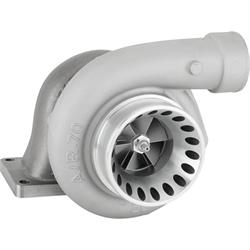
The centerpiece is obviously the turbocharger. You can piece together your own setup or buy a pre-engineered kit. If it’s your first turbo build, a kit can be very appealing. For example, Speedway Motors offers a small-block turbo kit that provides the major hot-side and cold-side components to bolt twin turbos onto a small-block. This kit includes two 66mm T4 turbos(capable of supporting roughly 800 flywheel hp with ease), SBC turbo headers, turbo wastegates, V-band adapters, oil feed/drain fittings, charge tubing, air filters, a blow-off valve, and more. It takes much of the guesswork out of assembling a turbo system.
On the other end, budget builders often piece together used or generic components. For instance, message boards are all about using junkyard turbos from a diesel truck or affordable aftermarket units, plus DIY log manifolds or flipped stock manifolds to mount the turbos. This can save money but requires more fabrication skill and usually more troubleshooting. It’s worth noting that turbo tech has come a long way. Today, even budget-friendly aftermarket turbos are available brand new for reasonable prices, and basic SBC turbo headers or a SBC hot side kit can be bought off the shelf. A “hot-side” turbo kit includes just the exhaust headers, piping, and wastegates, letting you choose your own turbochargers separately.
A turbo 350 will need significantly more fuel supply than stock. Plan on upgrading to a high-flow fuel pump. The fuel pressure regulator is also critical. In carb setups use a rising-rate regulator that increases fuel pressure 1:1 with boost so the carb sees constant pressure. EFI setups will already have this concept built-in. Additionally, fuel injectors (if EFI) must be sized for the horsepower. If you’re sticking with a carburetor, you’ll likely need to modify it for blow-through service or purchase a carb that is purpose-built for boost.
An intercooler cools the compressed air, greatly reducing chances of detonation and increasing power. If you are running more than about 6-8 psi on pump gas, an intercooler is highly recommended. There are many front-mount intercooler options that can fit in classic cars with some bracket fabrication.
Turbo exhaust needs are a bit different from normal headers. If you use a kit, it will come with turbo manifolds or headers. Ensure your wastegate is plumbed in a priority location like the merge collector so it can efficiently control boost. Too small a wastegate is a common error that causes boost creep.
Your radiator and cooling system will have to deal with more heat, as a turbo engine tends to run hotter. Make sure you have a good radiator, perhaps a high-flow water pump, and an oil cooler if space and budget permits. Also consider a turbo heat shield or turbo blanket and wrapping hot pipes. This keeps under-hood temps down and improves turbo efficiency by keeping heat energy in the turbine.
A boosted engine benefits from precise ignition control. If running a carb, you might use an MSD 6-BTM box which can retard timing as boost rises. If you’re running EFI, the ECU will handle timing maps. Just ensure you have a 2- or 3-bar MAP sensor that can read boost so the computer knows how much pressure is in the manifold. An aftermarket EFI system like the Holley Sniper or FiTech not only fuels the engine but also can control spark, cooling fans, and even boost control in some cases. These systems simplify a lot of the old problems hot rodders struggled with.
SBC Turbo Carb Setup vs EFI Conversion
One big decision for adding a turbo to a SBC is fueling strategy. Do you stick with a carburetor or convert to electronic fuel injection? Both paths are viable, and each has pros and cons. We deep dive into the fuel injection vs carb debate, but for a turbo SBC engine, both paths are viable and come with a unique set of pros and cons.
Running a carburetor with a turbo usually means configuring it in blow-through mode. The turbo blows pressurized air through the carb, typically via a hat on the carb. A standard carb needs modifications to work properly under boost. The biggest advantage of a carbureted setup is simplicity and cost. If your engine is already carbureted, staying carbed can save a lot of complexity and cost. A well-tuned blow-through carb can make as much power as EFI at wide-open throttle.
The downside is carbs are harder to tune to work properly across all conditions. The carb relies on mechanical circuits and sometimes compromises must be made. For example, a carb’s fuel curve might be spot-on at WOT, but it could run rich or lean in transient areas. Tuning a blow-through carb to have good low-end drivability and safe high-RPM fueling is an art.
Converting to EFI involves adding electronic fuel injection, either a throttle-body injection (TBI) unit that replaces the carb or port injected with a throttle body and fuel injectors in the intake manifold runners. In either case, you’ll use sensors (MAP sensor for boost, throttle position, air temp, coolant temp, etc.) and an ECU to meter fuel and manage ignition. A popular option for retrofits is a self-learning TBI system like the Holley Sniper or FiTech. These units sit on a 4-barrel intake and have built-in injectors and sensors. They have the advantage of being able to handle boost right out of the box. For ultimate control, a multi-port EFI with a standalone ECU gives you even more tuning capability.
For a budget or old-school approach, a turbo blow-through carb can work well and make serious power. It keeps things mechanical and might save money. However, it requires careful setup and isn’t as forgiving if something isn’t quite right. EFI offers more precision and usually easier to tune. It shines in part-throttle drivability and quick adaptability. The trade-off is cost and complexity.
Best Turbo SBC Cylinder Heads
How do cylinder heads and intake manifolds factor into a turbocharged SBC build? This is a great question, because you might think “I have boost forcing air in, so heads and intake don’t matter as much.” It’s true that a turbo can compensate for some airflow restrictions, but cylinder head flow and intake design still play a significant role in the engine’s efficiency and power potential.
In any engine (boosted or not), airflow is king. Getting more air/fuel in and out is how you make power. A turbo will force-feed air in, but better flowing heads will allow you to make the same power at lower boost compared to restrictive heads. If you have very low-performance heads, you can still bolt on a turbo and see huge gains, but you might need, 12 psi to reach a power level that a good aftermarket head might achieve with only 8 psi.
So, what heads are ideal for a turbo 350? If your budget allows, a set of aluminum heads with modern ports, larger valves, and good combustion chambers can dramatically improve airflow. For example, an AFR, Dart, Brodix, or Profiler head in the 180cc–220cc intake runner range can support a ton of power and will outflow stock heads by a mile.
What about stock heads? If you’re truly on a tight budget, you can run a turbo with stock iron heads. Vortec iron heads, for instance, flow fairly well on the intake side and can support decent power. Just ensure they’re in good shape, and maybe consider upgrading the exhaust valves to handle the extra heat generated by a turbo. Good head gaskets and a set of ARP head bolts are also a great idea to keep from burning a head gasket.
If your goal is an extra 100-150 hp over stock via a mild turbo, you might not need to swap heads. The turbo will force enough air in to meet that. But if you want a large gain (doubling horsepower or more), the stock heads become a bottleneck. For example, a stock 350 with small valve heads might struggle to flow enough above 5000 rpm even if you crank up the boost. You’ll see manifold pressure climb without proportional power gain because the heads just can’t move more air. For a deeper dive check out our guide here on the best SBC cylinder heads.
Best Turbo SBC Intake Manifold
Intake manifold choice depends on your fueling method (carb or EFI) as discussed earlier. For a blow-through carb, the intake manifold should ideally be an open-plenum (single plane) design for best distribution of the pressurized fuel/air mix. Single planes have a large central plenum that each cylinder draws from. Comparing single vs dual plane intake manifolds on boosted applications, a single-plane intake typically comes out on top. Under boost, its open plenum design helps equalize the air/fuel mixture across all cylinders unlike a dual plane, which separates the plenums between different cylinder banks.
Best Specs For SBC Turbo Camshaft
The camshaft plays a huge role in how an engine behaves. When you add a turbo, the ideal specs can change compared to a naturally aspirated SBC camshaft kit. Back in the day, turbo cams were ground with wider lobe separation angles (LSA), slightly less overlap, and sometimes more exhaust duration than intake. The logic is to reduce valve overlap so you’re not sending fresh boost charge out the exhaust during the overlap period, and also to help push exhaust out against the turbo.
This came from the days when turbos were less efficient and created a lot of exhaust backpressure. But modern turbo technology has improved significantly. Many properly sized turbos with free-flowing exhaust manifolds have back pressure equal to or even less than boost pressure. This has led to some rethinking of cam designs. With efficient turbos, you don’t necessarily need an excessively wide LSA. That said, for most typical street turbo builds, an LSA in the 112-114° range is still a good, safe spec to ensure minimal overlap. It’s kind of a no-brainer that works in most cases.
Turbo cams often have similar intake duration to an NA cam for the same RPM range but may add a bit more exhaust duration. For example, a naturally aspirated 350 aiming for 6,000 RPM peak might use a cam around 230 degrees of duration at 0.050 inches of tappet lift on both intake and exhaust. A turbo cam for the same might use 230 on the intake but 240-245 on the exhaust. The reason is the exhaust gets pushed out against turbine pressure, so giving it a little more time to clear can help scavenge the cylinder. However, too much exhaust duration can also slow spool, by bleeding off pressure, or make the engine soft off-boost. It’s a balance.
Lift is generally similar to NA cams. Turbo cams don’t need sky-high lift for the sake of it, but there’s no harm in lift as long as the valvetrain can handle it. Because a turbo engine can make great torque without revving to the moon, you might choose to keep the rpms lower and stay away from a crazy high-duration cam. That way you can often stick to a moderate lift that’s easier on springs.
Most turbo setups will benefit greatly from a camshaft ground to match the application. The best specs depend on your goals, but the common theme is wider LSA, moderate overlap and a bit more exhaust. If you already have a mild cam (ground for towing or RV), that might actually perform decently with a turbo. Mild cams often have wide LSAs and low overlap by nature. Check out our complete guide explaining camshaft specs for more information on how camshafts work and why lobe separation angle matters.
Maintenance and Tuning for Turbo Small Block Chevrolet Performance
Building a turbo SBC is one thing, keeping it running strong is another. Boosted engines place new demands on maintenance and tuning compared to your average naturally aspirated small-block. If you want your turbo 350 to live a long, happy life, you’ll need to adopt some boost-specific maintenance habits.
Turbochargers are very hard on engine oil. The turbo’s bearings endure extreme heat from exhaust and can coke oil into crusty deposits if the oil breaks down. Additionally, turbos shear the oil because of high RPM and can contaminate the oil with fine particles from wear. As a result, frequent oil changes with high-quality oil are a must. Don’t try to run 10,000 miles on cheap dyno oil with a turbo. You’ll want to use a good synthetic oil that can handle high temperatures, and change it often. Some say every 2,000-3,000 miles for a hard-used turbo engine, or at least every six months if driving sporadically. Regular oil changes help avoid oil contamination issues that can destroy the turbo’s bearings. Also, always let the oil get to temperature before pushing the car hard, and consider letting the engine idle for a minute or two after heavy boost runs to cool the turbo.
Turbo engines typically need colder heat range spark plugs to avoid overheating the plug tips under boost. These plugs will foul easier, so keep them fresh. In fact, expect to change spark plugs more frequently in a turbo engine than you would in NA. High cylinder pressure can also expose any weakness in your ignition system, so use good plug wires, ensure your distributor/coil or coil packs are up to snuff, and consider tightening the plug gap a bit to avoid spark blowout under boost. It’s common practice to run 0.025-0.030 inch gaps on high-boost setups, versus 0.045 stock.
Perhaps the most critical aspect of turbo engine longevity is the tune. Running lean or with too much timing under boost will cause detonation, and that will quickly hammer pistons, rings, or head gaskets. If you’re using a carb, you’ll need to read spark plugs, monitor how the engine feels, or ideally use a wideband O2 sensor to keep tabs on air-fuel ratios. With EFI, take advantage of its feedback. Ensure the commanded AFR is rich enough, most turbo engines make best power safely around 11.5-12.0:1 AFR on gasoline and that you’re not getting knock.
Lastly, know that a highly stressed turbo engine probably will require a rebuild sooner than a mild NA engine. That’s just reality. You’re pushing a lot more power per cubic inch. Even with great care, parts wear out faster. But that’s all part of life with a turbo toy. With proper care, a turbo 350 can serve you well for many miles of boost-fueled exhilaration. Just give it the love and maintenance it needs, and it’ll return the favor with reliable, explosive performance whenever you hit that loud pedal.
Avoid These Common Turbo Small Block Chevrolet Mistakes
When adding a turbo to any engine, there are some classic pitfalls that newcomers (and even experienced builders) can fall into. Steering clear of these will save you money, time, and possibly your engine’s life.
Using the Wrong (or Cheap) Turbo: An oversized turbo will give laggy performance and narrow the powerband. Meanwhile, a too-small turbo chokes the engine at high RPM and can overspeed it trying to keep up. Don’t grab the first eBay special you see or a turbo meant for a 4-cylinder and assume it’ll work. Also, ultra-cheap no-name turbos can be a gamble. If you buy on a budget, at least buy from a source with good reviews. Remember, a blown turbo can send metal through your engine, costing you significantly more than that $200 you saved up front.
Lack of Supporting Fuel System: Probably the number one turbo engine killer is running lean under boost due to inadequate fuel. This mistake can happen by not upgrading the fuel pump, using injectors that are too small, or simply tuning too aggressively. The result is detonation and burned pistons. Always err on the side of too much fuel system. A wideband O2 sensor is a great safeguard.
Too Much Compression for Pump Gas: Trying to turbocharge an engine with high compression on pump fuel is asking for trouble. It’s a common rookie mistake to leave a 10:1 short block as-is and just “run low boost.” But even a little boost with that much compression can demand more octane than pump gas has to offer. You end up either detonating or pulling timing so much that power gains are minimal.
Poor Oiling Setup: Turbos need a good oil feed and unrestricted drain. A few common mistakes are tapping an oil source with insufficient pressure or volume, using too small a drain line, or mounting the turbo too low so oil can’t gravity-drain properly. This can cause oil to back up in the turbo, leading to smoking, or starve the turbo bearings if feed is inadequate. Feed the turbo from a pressurized oil gallery (often the port near the oil filter or where the stock pressure sensor goes) and use the right size restrictor if required (some journal bearing turbos take a lot of oil, ball-bearings need less). The drain should be as straight and large as possible going into the pan above the oil level. No sharp kinks, no uphill sections. If the turbo must sit low, use a scavenge pump. Also ensure the crankcase is ventilated using a PCV valve or a breather because high crankcase pressure can slow the drain.
Chasing Peak Power at the Expense of Drivability: It’s easy to get obsessed with dyno numbers or running max boost for bragging rights. But an engine that makes 600 hp on paper but drives terribly is a common outcome of that approach. Tune for real-world performance, not just peak glory. A well-tuned lower boost setup will often outrun a sketchy high-boost combo on the street.
Ignoring Common Sense Maintenance: Some folks get excited and forget that boosted engines need a keen eye. Skipping that oil change or not gapping your spark plugs properly for boost can come back to bite you. Stay on top of maintenance and checks. If something sounds or feels off, investigate. Don’t assume “it’s just a turbo thing” and ignore it.
Turbocharging a small-block Chevy can be a highly rewarding endeavor, but it has less tolerance for errors than a basic engine build. Plan carefully, tune conservatively, and listen to your engine. Do that, and you’ll enjoy mile after mile of boosted bliss in your small-block Chevy, with far fewer headaches along the way. Happy boosting!