$828 Off


$828 Off
|
#8331000
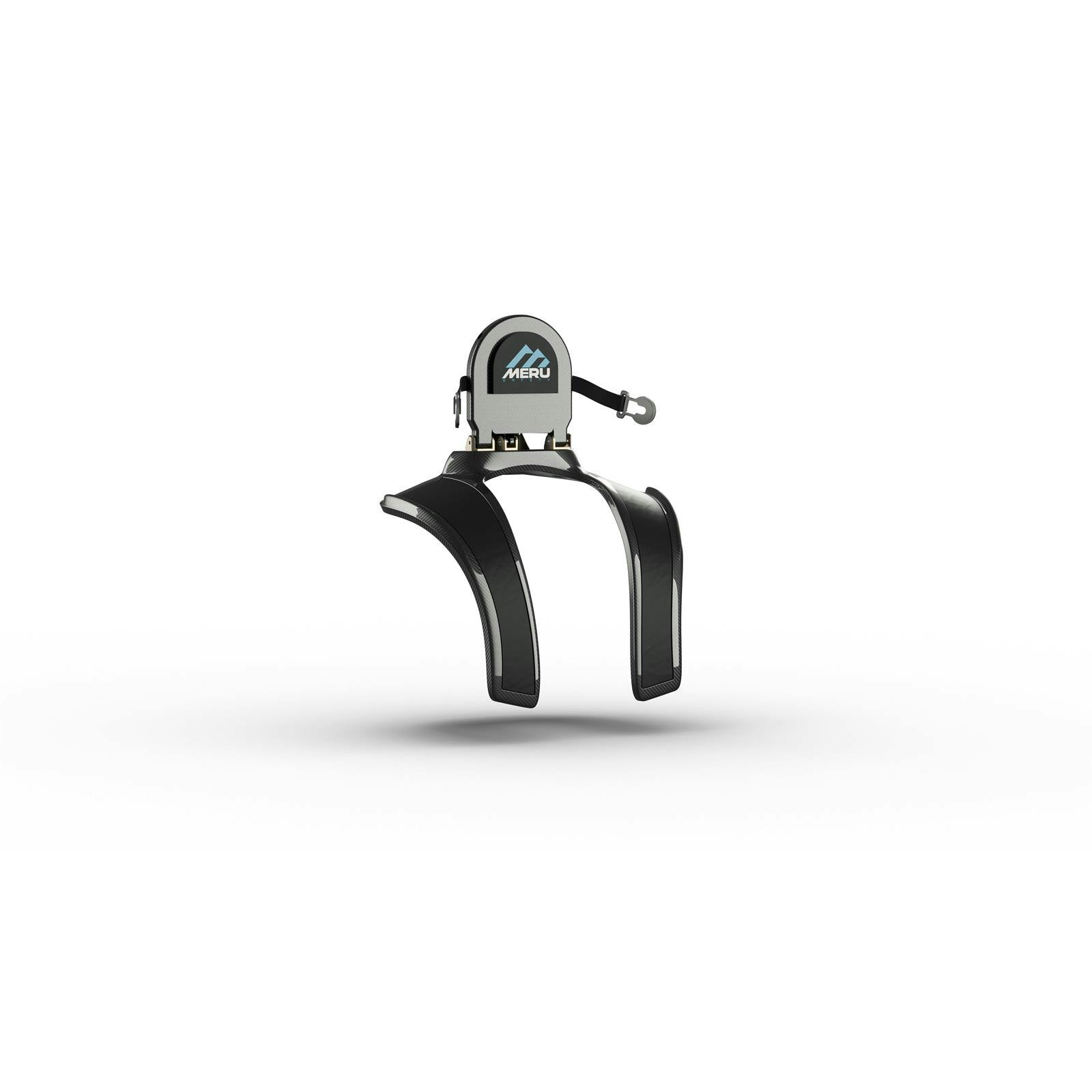
Meru Safety Ascent Head And Neck Restraint With IDS
- Discontinued
- Item is new and in unused condition. This product will no longer be stocked by Speedway Motors
- Fully customized CNC’d dampener with proprietary IDS technology featuring speed sensitive valving to maximize both safety and comfort.
$421.52
/each
In Stock
$1,250.00
Save $828.48
Quantity
Need Help? Call to Order
Add to a list
Product Summary
Complete Restraint System Restraint Component
- Discontinued
- Item is new and in unused condition. This product will no longer be stocked by Speedway Motors
- Fully customized CNC’d dampener with proprietary IDS technology featuring speed sensitive valving to maximize both safety and comfort.
- Moving headrest allows for universal use in all seating positions.
- A major reduction in concussion causing forces in a 70G Impact.
- Carbon Fiber Headrest and Collar.
- Hundreds of pounds under the SFI and FIA upper neck tension threshold
Key Specs
| MFG. Part # | Select Size |
| Garage Sale Type | Discontinued |
| Restraint Component | Complete Restraint System |
| SFI Rating | 38.1 |
| Tether Type | Sliding |
Need To Know
Need help?
855.313.9176Ineligible for Return
Contains items that cannot be returned
Details
Details
Meru Safety makes the inherently dangerous sport of auto racing safer through its cutting edge grouping of protective equipment. Meru Safety currently provides a head-and-neck restraint and a helmet in the works that seeks to append current concussion prevention standards, and we have several more safety products in development. Meru Safety’s products protect auto racing drivers and in the future will revolutionize military and child car-seat safety. Since 2016, Meru Safety has developed, patented, and procured technology that aims to reduce concussion-causing forces.
The Meru ASCENT is SFI 38.1 approved. The Ascent Carbon is the newest technology in the head and neck restraint market for concussion prevention.The device applies the industry changing Inertia Dampening System(IDS) to drastically reduce concussion causing forces without giving up neck safety. The Ascent Carbon Brace is a full carbon head and neck restraint with stainless and aluminum hardware. A hydraulic shock absorber is built into the backplate of the device to help dampen head movement throughout the entire length of impact.
- Hollow Carbon Fiber Collar with non-slip belt grips
- Custom molded honeycomb infill padding with Nomex wrapped padding covers
- Oversized for maximum protection
- Honeycomb pattern allows pad to remain firm enough to maintain car-feel but enough give for comfort.
- Magnetic Locating Helmet Anchors
- Fire resistant kevlar webbing sliding tether with magnetic blended Stainless steel helmet mounts
- Hinged collar and headrest design with a hydraulic shock absorber
- Fully customized CNC’d dampener with proprietary IDS technology featuring speed sensitive valving to maximize both safety and comfort.
- Moving headrest allows for universal use in all seating positions.
- Reduces the force through the head on the Z axis to 53G’s in a 70G impact.
- Hundreds of lbs under the SFI upper neck tension threshold.
- Works with all seating positions
- Weighs about 2 pounds
- A major reduction in concussion causing forces in a 70G Impact.
- Hundreds of pounds under the SFI and FIA upper neck tension threshold.
- Carbon Fiber Headrest and Collar.
- Carbon Kevlar burst panel.
- Fully customized CNC’d dampener with proprietary IDS technology featuring speed sensitive valving to maximize both safety and comfort.
- Moving headrest allows for universal use in all seating positions.
- Optimized for multiple impacts.
- IDS can withstand thousands of impacts
- For use with 5 or 6 point harnesses
- Helmet tethering points required
ANGULAR ACCELERATION
The medical community has determined that angular acceleration (rotational force generated during oblique-angle impacts) is the primary cause of concussion and traumatic brain injury. The forces to the head in the majority of auto racing accidents come from rotational energy which promotes angular acceleration. It has become rare to have a direct linear impact to the head. Traditional FHR’s solid construction and tethering prevent the ability to mitigate angular acceleration forces. With traditional FHR’s in an impact the brain and head immediately speed up and then come to an immediate stop when the tether stops the helmet having a similar effect to hitting your head on a wall despite not leaving a scratch on the helmet.
IDS technology immediately begins slowing the impact down, controlling the helmet's entire movement forward thereby reducing the transfer of angular acceleration forces to the head and brain which are the mass majority of auto racing accidents.
LOW-THRESHOLD ENERGY
Recent medical research has provided alarming conclusions surrounding the causes, severity, and long-term effects of concussions. Even seemingly minor concussions may have much more serious long-term effects on the brain, especially when frequency is increased.
The current FHR’s focus is on limiting upper neck tension. Concussion prevention is left up to the helmet companies. The vast majority of impacts one might experience in auto racing qualify as low-threshold energy impacts; impacts well below certification standards pass/fail velocities, but severe enough to sustain a concussion or traumatic brain injury (TBI). Bumpy tracks, a big cushion in dirt cars, or a string of small crashes can do enough jarring to sustain a concussion or TBI without any obvious carnage to pair it with. IDS starts working the instant an impact again, and the speed sensitive valving makes the technology more compliant and progressive over a broad range of impact velocities common in ‘real world’ racing, while still exceeding the global standard pass/fail requirements.
HIGH-VELOCITY IMPACTS
Across the entire range of potential impact velocities, the Meru Ascent FHR with IDS technology focuses specifically on concussion prevention. Meru meticulously engineered the collar, headrest, hardware, guards, and IDS to provide the best possible impact mitigation performance across all impact velocities for both angular and linear accelerations.
In a 70G force impact at the CAPE Crash Testing Lab in Indianapolis, the Meru Ascent FHR with IDS reduced concussion causing forces through the head on the Z axis to just under 53G's. We were able to make those gains without giving up low-threshold energy protection or sacrificing neck safety.
TIME-TO-PEAK (TTP)
Time-to-Peak (TTP) is how long it takes the energy of an impact to reach maximum g-force. Deceleration time is the single most beneficial component in reducing the severity and magnitude of any impact — the more time, the less energy transferred. Due to our proprietary IDS technology, our speed sensitive dampener progressively lowers the heads velocity and almost triples the time to peak, spreading our already drastically reduced load, over almost triple the time.
UPPER-NECK TENSION
The original FHR’s were designed to limit upper neck tension. At the time auto racing's biggest problem was basal skull fracture. Caused by the whiplash motion in an impact, basal skull fractures often severe spinal cords leaving the driver dead on impact. The original FHR designs did wonders for limiting how far forward the helmet could travel in an impact eliminating the finished whipping motion.
In testing to see how well FHR’s do at preventing basal skull fracture, we look at upper neck tension. This number is the main pass fail standard for the safety organization. In our mission of concussion prevention, the original FHR goal of lowered upper neck tension was not lost on us and we were able to come in several hundred pounds below the set standard either matching our besting the current industry leaders.
Specifications
Specifications
| KEY SPECS | |
|---|---|
| MFG. Part # | Select Size to see |
| Brand | Meru Safety |
| Garage Sale Type | Discontinued |
| Restraint Component | Complete Restraint System |
| SFI Rating | 38.1 |
| Tether Type | Sliding |
| GENERAL | |
| Safety Restraint Type | Magnetic Locating Helmet Anchors |
| Molded Pad Included | Yes |
| Material Type | Carbon Fiber |
| Hardware Included | Yes |
| Sold in Quantity | Each |
| GTIN Code | Select Size to see |
Ratings & Reviews
Ratings & Reviews
Questions & Answers
Questions & Answers
Be the first to ask a question.