Order a Free Catalog
Click Here to request one of Speedway's FREE catalogs!
Speedway Motors is America’s Oldest Speed Shop® and has been a trusted source for high performance parts for street rods and racing for over 74 years. Speedway Motors has built a reputation for providing friendly expert advice and superior service. Whether you are racing, building a street rod or restoring an old classic, Speedway Motors has the performance parts you need – in stock and ready to ship today.

The Dreaded Wiring Issue
Speedway Tech Team
Created 2014
You are a grease monkey. You can change brake pads with your feet, while rebuilding an SB350 with your eyes closed. If it is oily, dirty, dusty, or any combination of those you are happy. There is one thing that terrifies you however: wiring. Something about the miles of convoluted wires snaking in and out and around and under scares the 40-weight oil out of you. It’s okay, were here to help. (Kind of.)
Now, the sheer number of potential wiring issues cannot be covered in this one article. In fact, entire books have been written about electrical diagnostics. What we want to cover here are some of the more common ailments the owner of a classic car might (most likely will) encounter.
Grounding

Grounding is often one most overlooked issue when it comes to wiring. Essentially, the electrical system is a circle. Without a proper ground making good connection, that circle is open and ineffective. Look over your grounding points and make sure that the connections are solid, not rusted out, and are tight. Remember your locations also: battery to frame, frame to body, engine to frame and body. You would be surprised the routes electricity will take to try and ground.
Wiring Insulation

We all know that mice seem to find the insulation on our wiring absolutely irresistible. This can and has been known to cause some serious headaches for new owners. A thorough inspection of the wiring is a must. The best place to start is anywhere the wiring lays across the engine, or butts up against a frame rail. These are the likely avenues a mouse will take as they are bouncing around looking for something to snack on.
Ignition Switch (too many draws)
All too often when you are adding things to your classic (or the previous owner was adding things), you will need a power source. Unfortunately, most of the time that power sourced was tapped off of the back of the ignition switch. Not good. We have alternate power blocks and relays available, and these are by far the better, (read: safer) alternative.
Corrosion Issues on Circuits
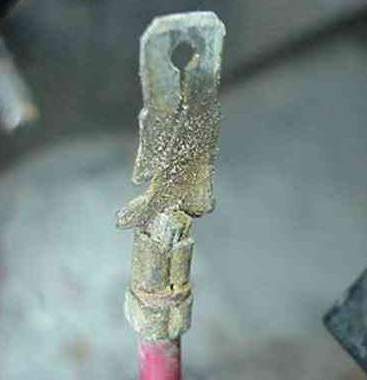
Over time, the terminals on the original circuits that are integral to your cars’ electrical system can become corroded, overloaded, and break apart. Remember that comment about the circle? If a terminal doesn’t have a good connection due to corrosion (like the one on the right), that circle is incomplete.
6 Volt Systems
Basically, the run here is that the original 6 Volt systems found in many classic cars, usually prior to the mid-50’s, is a solid system. The consensus in the office is that since the 6 Volt systems use such a heavy wire, if the insulation is still good, use it. Your 12V system operates on a lower amperage than 6V, so if the wiring is still in good condition you can use it. Don’t forget about the clocks, radios, gas gauges and other components that need to be updated to 12V capable units though. You won’t like the results.
One last thing: keep the size and rating of your battery in mind. If you have a small battery for your classic, it may not be powerful enough to handle the draw of the electrical system.